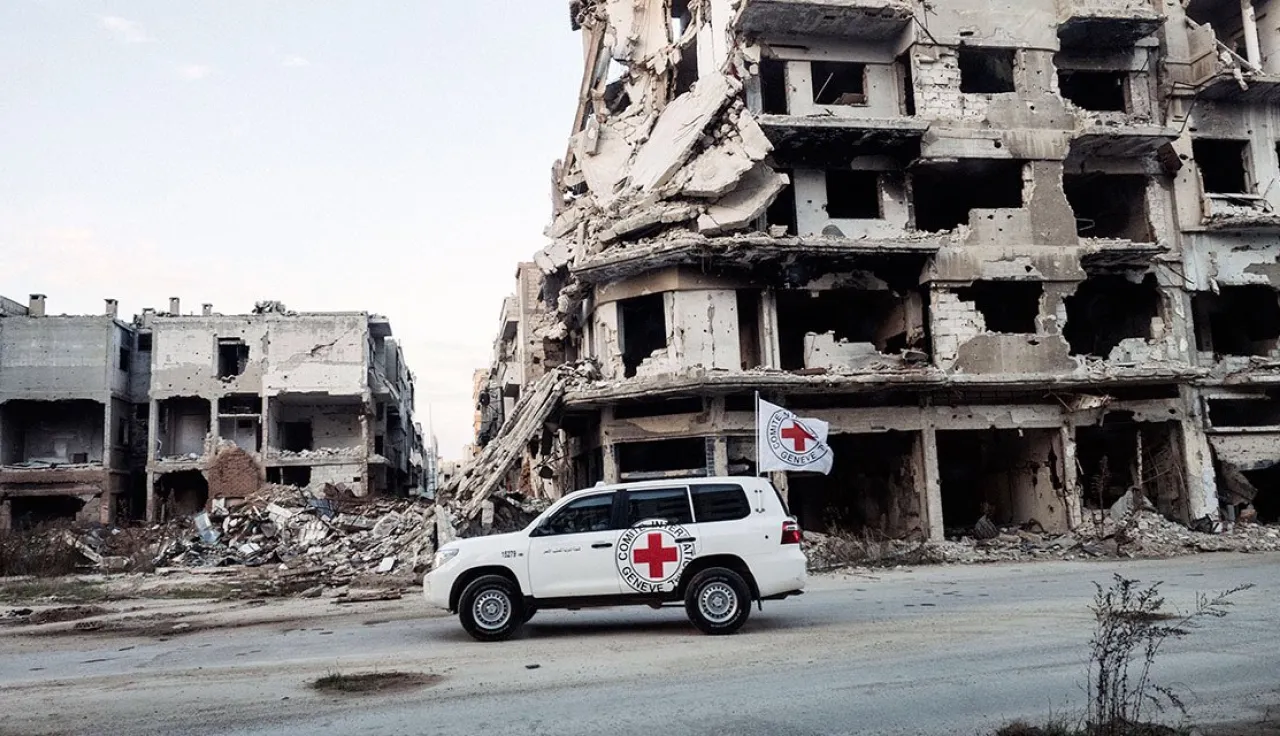
Geneva Conventions and the law
International humanitarian law is based on treaties, in particular the Geneva Conventions and their Additional Protocols, and a series of other conventions and protocols on specific topics. There is also a substantial body of customary law that is binding on all States and parties to a conflict.
By Jun Enriquez
Geneva (ICRC, 03 Nov.2026) – States have set out practical steps to strengthen respect for international humanitarian law (IHL) as civilians face unacceptable suffering in more than 130 armed conflicts. Published ahead of the Global IHL Dialogue in Geneva this week, and the High-Level Conference on Humanity in War in Jordan in December, the guidance is intended to help turn renewed political commitment into action that better protects people caught in conflict.
"We witness emboldened warring parties adopting overly permissive or outright dismissive interpretations of international humanitarian law that perpetuate rather than prevent suffering," said Mirjana Spoljaric, president of the International Committee of the Red Cross (ICRC). “What is needed now is the political will to make international humanitarian law a priority at the highest level and to uphold it in military decisions.”
The guidance identifies several areas for action to strengthen respect for international humanitarian law. For instance, it provides ways for states to counter narratives and behaviour that portray individuals or groups as less deserving of protection. This includes guidance for armed forces on how to refer to the enemy and civilian populations, monitoring social media use by armed forces and public authorities, and integrating humanitarian values into civic education and national commemorations.
Protecting civilians also means protecting the services their lives depend on. The guidance offers concrete measures for states to effectively preserve access to health care, water, electricity, sanitation and communications. This can include establishing protected zones around essential infrastructure, placing medical facilities on no-strike lists, improving civil-military coordination and maintaining safe maritime corridors for essential goods.
States are also urged to ensure that new technologies strengthen - rather than undermine - protection in armed conflict. This includes continuously reviewing and cross-verifying information on potential targets and regulating personal digital devices in operational settings to help prevent sexual violence and the recruitment of children.
Twenty-seven states from five continents led the discussions on these issues with the aim of demonstrating that it is feasible to respect the rules of war and protect civilians in contemporary conflicts. Warring parties, and those that support them, now have a clear roadmap. With political will, they have the power to improve the situation for the millions of people caught up in war.
It was noted that the event were hosted by
Switzerland and the International Committee of the Red Cross, the Global
IHL Dialogue is a two-day meeting where states, civil society and other
stakeholders are invited to engage on the outcomes
of two years of state-led consultations, involving more than 160
states, on how the rules of war can be better applied in practice to
protect civilians and limit suffering. These consultations informed the
identification of practical, non-binding guidance
issued ahead of the 3-4 November meeting in Geneva. The dialogue will
be followed by a high-level conference on 7 December in Jordan, hosted
by His Majesty King Abdullah II, where leaders of the 127 states that
have officially joined the Global IHL Initiative
will be invited to demonstrate political commitment to the rules of
war. (ICRC news release and photo; Written and Edited by Jun Enriquez, Digital-Mobile Journalist)


